

AI Boom or AI Bubble?
When generative AI can generate everything but ROI


I was writing something this week that caused me to look up what movie contains the line, “I’m gonna look out for myself, and I’m gonna get mine.” (Do you know the movie?). I consulted Google search and the Gemini answer helpfully came back with text explaining that the quotation comes from Remember The Titans. Then it gave me the context, the name of the character who said it, and the name of the character he said it to.
Then Gemini unhelpfully offered me a link to the relevant clip. I followed the link to find the scene from Seinfeld—I don’t even remember the context—in which Elaine ends up in a feud with George’s father, Frank Costanza. In the clip Gemini fed me, Frank says to Elaine,
“You sayin’ you want a piece of me?”
Elaine: “I could drop you like a bag of dirt.”
Frank responds, “You want a PIECE OF ME!? YOU GOT IIIITTTTTTTTT!!!” Then the elderly man, Frank, charges Elaine and Elaine winds up to punch him in the face just as the video freezes, the credits roll, and the familiar synthesized slap bass closes out the episode.
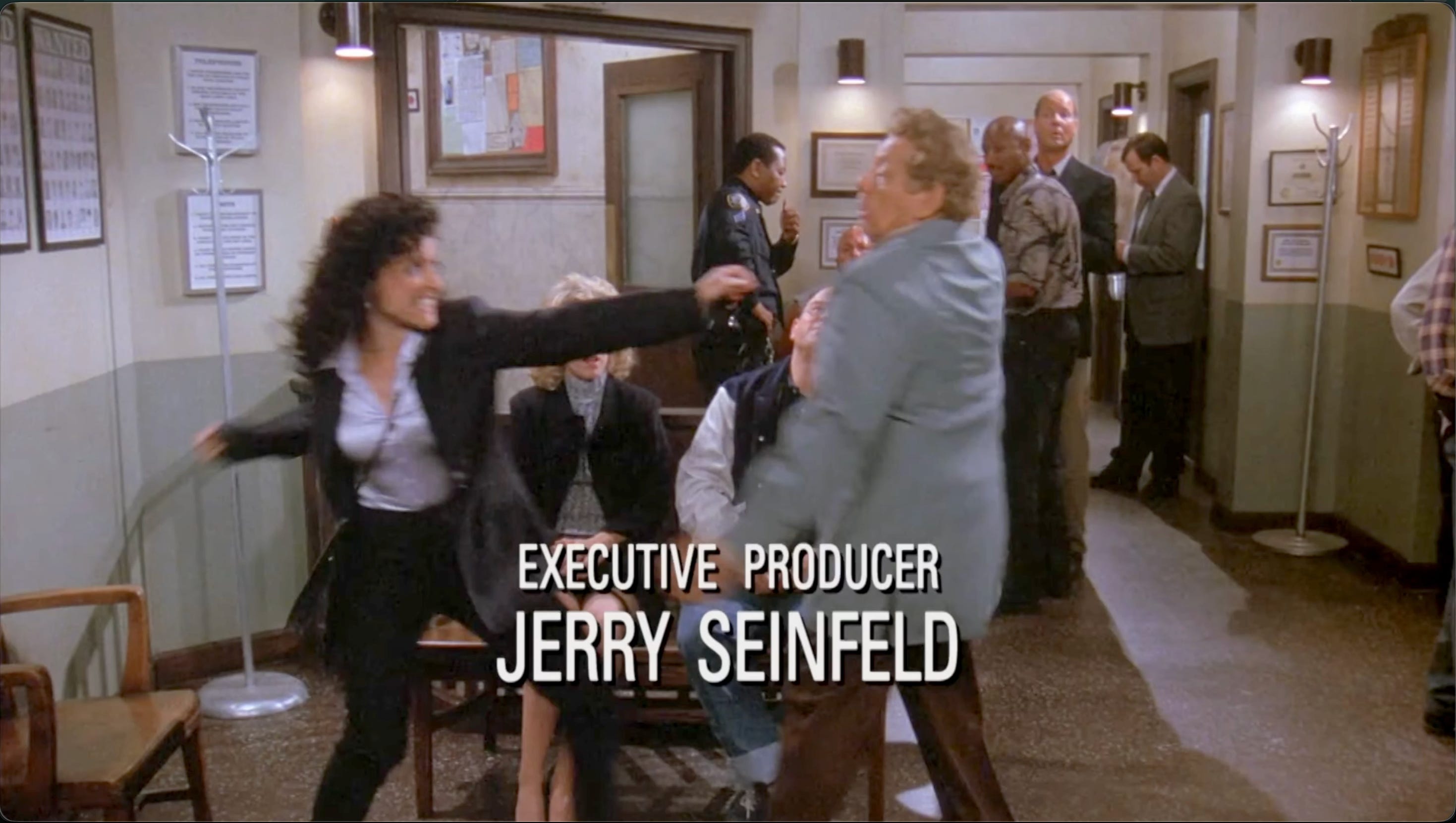
Hold that thought.
There is an ongoing debate as to whether we’re in the middle of an “AI Bubble.”
A financial bubble is a condition in which the valuations of companies in a specific sector expand rapidly and then contract rapidly. In my lifetime, there have been two major bubbles whose bursting had rippling effects throughout the US—and in fact the global—economy. The first was the dot com bubble which burst in 2000 and the second was the housing bubble that burst in 2008.
Because of the many similarities, I’m going to use the dot com bubble as the closest point of comparison. I’m no expert in any of this, so here’s my “use your blinker” disclaimer: I’m going outside my lane here (see Episode 1!).
Use Your Blinker! (Episode 1)

Have you ever been told to “stay in your lane?” Depending on the context, it means you should stick to your area of expertise, or to your professional experience, or to your specific subject.
Investors invested heavily in IT companies often pre-profit (and sometimes even pre-revenue). The sense among investors was that the mere fact of the internet made so much new revenue possible that they would be foolish not to invest heavily even in these early stage funding rounds. By 1999, the total investment in IT ($17.1 trillion) became almost double the entire United States gross domestic product (GDP, $9.9 trillion). Ultimately, many of those companies were unable to deliver on investors’ expectations, which rapidly decreased stock price: That fast contraction was the bubble bursting.
Today, investment in AI is a little bit like investment in the dot com industry in the late 1990s. AI investment—to include, not just the deep learning models, but also the infrastructure required to train and run those models—is enormous. Though it’s hard to pin down a figure for the total investment in AI, even if we just add up the market cap of the biggest AI companies out there, say, Nvidia, Microsoft, Apple, Google, Meta, and OpenAI, we get about $17.4 trillion. If the US GDP is $29.2 trillion, then then the AI investment surveyed here is only about half of US GDP.
Surely these six companies aren’t the only companies investing in AI. So, we know national investment in AI must be bigger than $17.4 trillion, but it’s hard to say just how much bigger. But let’s suppose—hear me out—let’s just suppose that the total US investment in AI is 3x that $17.4 trillion number. I think that may be a stretch, but let’s imagine together. $17.4 trillion times 3 is $52.2 trillion—and that’s roughly twice US GDP.
Under these very unscientific and entirely arbitrary numbers, the investment in AI is as large, relative to US GDP, as the dot com investment was in 1999.
But, whether we’re in a bubble does not depend exclusively upon how much people are investing. It depends on whether we’re headed for a rapid contraction in valuation.
So, the real question is this: Do we think the market cap of these major AI companies is about to shrink rapidly?
Jensen Huang, the CEO of Nvidia, made news this week from his headlining comments at the Nvidia GPU Technology Conference (or just, “GPC”) in Washington, DC. Among other things, Huang argued that we’re not in the midst of an AI bubble. He told Bloomberg,
I don’t believe we’re in an AI bubble. And the reason for that is, we’re going through a natural transition from an old computing model based on general purpose computing to accelerated computing. We also know that AI has now become good enough, because of reasoning capabilities, its ability to think, it’s now generating tokens, and now generating intelligence that’s worth paying for.
As I see it (again, not an expert), whether our current moment is comparable to the dot com moment in 1999 depends on the degree to which AI is “worth paying for.”
In one sense, this moment is fundamentally different from the dot com moment. AI has already delivered real capability. Many of us, myself included, use it every day. Many of us see value in that use. This is different from the pre-revenue investments in the dot com age. AI has already proven its usefulness.
But Huang has given us only half the equation. Whether we’re headed for a rapid contraction in market cap (a bursting of the bubble) depends, not on whether AI is worth paying for, but on whether AI is worth what investors have paid into it. That’s a very different question.
Haung is, of course, right that we’ve seen developments in what is often called “reasoning” capabilities and in AI’s ability to generate training data for future models; but it’s not at all clear to me that the technology has reached a maturity required for investors to get a return on their massive investments.
Sometimes, when I engage generative AI on questions that pertain to my research and writing I am blown away at its capabilities. And sometimes, when it gives me information about Remember The Titans, it gives me links to Seinfeld.
I think we are headed for a contraction in the market. Whether, 25 years from now, we call that event the bursting of a financial bubble will depend on how rapidly in contracts. On that question, I’m much less certain. But I think it will depend, to at least some degree, on whether the average user continues to reach for generative AI has the option of first resort. It’s possible. But I have doubts.
Credit where it’s due
Views Expressed are those of the author and do not necessarily reflect those of the US Air Force, the Department of Defense, or any part of the US Government.
This piece really made me think. Your nuanced perspective on the AI bubble is exceptionally well articulated and I wholeheartedly agree.