

Language and Medicine Cups
A reflection on what it means to be human

Note:
This excerpt is part of a longer, unpublished project on language and artificial intelligence.
“Fine,” my dad said. “Take the medicine if you want. If you don’t want to take it, that’s fine, too!”
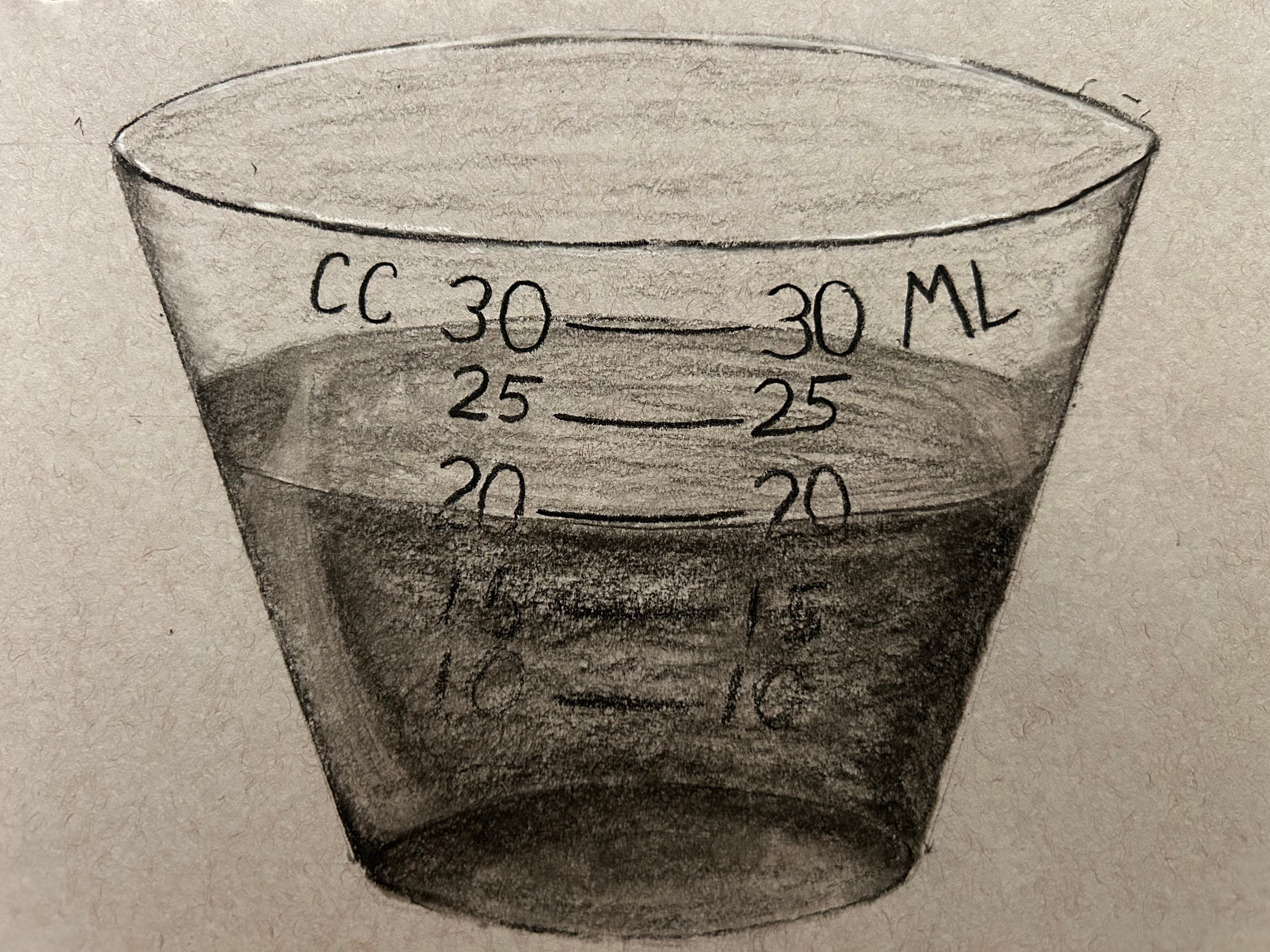
We three were in the kitchen of our little house in Palo Alto, California. My mom poured the thick amoxicillin suspension into the plastic thimble of a medicine cup. I was not yet two years old and it was my ear infection we gathered in the kitchen to treat. This was not the first dose, so we all knew what we were in for. My dad, a six-foot three Air Force officer and weightlifter held me with one arm and picked up the cup with the other. My mom, she was also in her mid-20s, is a diminutive woman, especially next to my dad. She prepared for what she knew would be a struggle to hold my arms down.
I don’t know if you’ve ever tried to hold a child of not-yet-two who doesn’t want to be held. I once held my own son while a doctor and nurse tried—tried—to draw blood from his arm. Kids that age have a spastic, writhing technique that cannot be taught and a core strength that borders on super-human.
In one corner were two grown adults. And in the other, a toddler on a mission. As the sun set over the Stanford campus, we were ready to rumble.
My young, healthy, athletic parents were no match for my wriggling on that day in Palo Alto. They struggled for what felt like ten or fifteen minutes to bring the little cup to my pursed lips.
You can imagine how my parents must have felt. They weren’t doing this for their own sake. They knew I hated every second of it, but they weren’t acting from viciousness and it wasn’t child abuse. They were trying to give me medicine to make me well. They were following doctor’s orders. What if they couldn’t get me to take it? What if my ear infection persisted and got worse? Every parent must have experienced this feeling at one point or another. Were they terrible parents? They wanted only to do what was best for me. And I refused to let them.
I was their second child, but that doesn’t mean they were prepared for this level of obstinacy. My older sister fit the classic mold of the first-born: obedient, responsible, dutiful (mostly). When she was not-yet-two, she may have writhed in protest or writhed in dismay. But she had never writhed to win. As so many parents know—and as I have learned first-hand—no matter how proficient a parent might feel raising one child, the next can shatter any pretense of parental competence. My parents had reached wits’ end.
Finally, after the full 12 rounds, the contest came to a close. I ended in victory and my parents resigned themselves to defeat. My dad took that little plastic cup and set it on top of the wooden trunk that had been my great grandfathers. The antique chest came up to my little chest at the same place a bar might come up to a barfly. Then he administered the proclamation.
“Fine! Take the medicine if you want. If you don’t want to take it, that’s fine, too!”
My parents stepped back from the trunk leaving my fate in my own tiny hands. At not-yet-two years old, I walked to the wooden trunk, grasped the little cup and slugged that shot of amoxicillin with a proficiency I wouldn’t earn until college.
***
I must have heard my parents tell that story a hundred times, but I don’t remember experiencing any of it. The story is always told from their perspective. It is their memories and their words that shape even my own understanding of events. Suppose I could access my own memories of that day from the depths of my cerebral cortex. Even then, I don’t know if I would recognize or understand them. For my parents, it was just another day—maybe a particularly memorable day. But it was a day that they experienced like any other. For me, though, it was a time before language. I don’t know what shape thoughts might take in the absence of words to describe them. And so, these many years later, I have no memory of the story; I have only memories of the words my parents have used to tell it.
I understand the punch line. I know why people laugh when they hear that story. They laugh because the little guy just wanted to do it himself.
Maybe.
But we are inferring a great deal when we claim to know how a child of not-yet-two thinks and feels and how he turns those thoughts and feelings into actions. Ultimately, it is impossible for us to know what I was thinking because I didn’t have the words to say. It is impossible to know if I really could use reason—whether I had the capacity to turn complex desires into actions to achieve those desires: “I want to do it myself, therefore I should flop around in my dad’s arms like a fish on the deck of a boat until they understand that I want to do it myself.” The fish can writhe without reason. Maybe the not-yet-two-year-old can, too.
It’s impossible for us to know.
We’re the only species that has language. And we’re the only species that has reason. And the two are so tightly wrapped up in one another I’m not sure we can ever disentangle them.
Maybe the ancient Greeks were right about the logos.
Credit where it’s due
Views Expressed are those of the author and do not necessarily reflect those of the US Air Force, the Department of Defense, or any part of the US Government.
In the beginning was the Word ...
Great piece.